

A technical overview of teak kiln drying as a critical factor in determining export outdoor furniture quality, covering moisture standards, precision manufacturing stages, structural stability, and compliance with international teak export requirements.
Technical Foundation of Teak Export Standards
In the export furniture industry, teak kiln drying is not merely a production step—it is the technical foundation that determines overall outdoor furniture quality. For technical buyers, procurement teams, and quality inspectors, moisture content is one of the most critical indicators of dimensional stability, structural strength, and long-term durability in international markets.
Teak naturally possesses superior characteristics for outdoor applications. However, without controlled drying, risks such as cracking, warping, or shrinkage may occur when products move from tropical production environments to regions with different humidity and temperature levels. For this reason, kiln drying has become an essential component of the teak export standard.
Precision in Every Step: The Journey of a Masterpiece
A systematic manufacturing approach ensures that every component meets rigorous international standards before becoming part of the final product. Below is a structured production process that highlights the importance of kiln drying in maintaining export-grade outdoor furniture quality.
1. Material Preparation
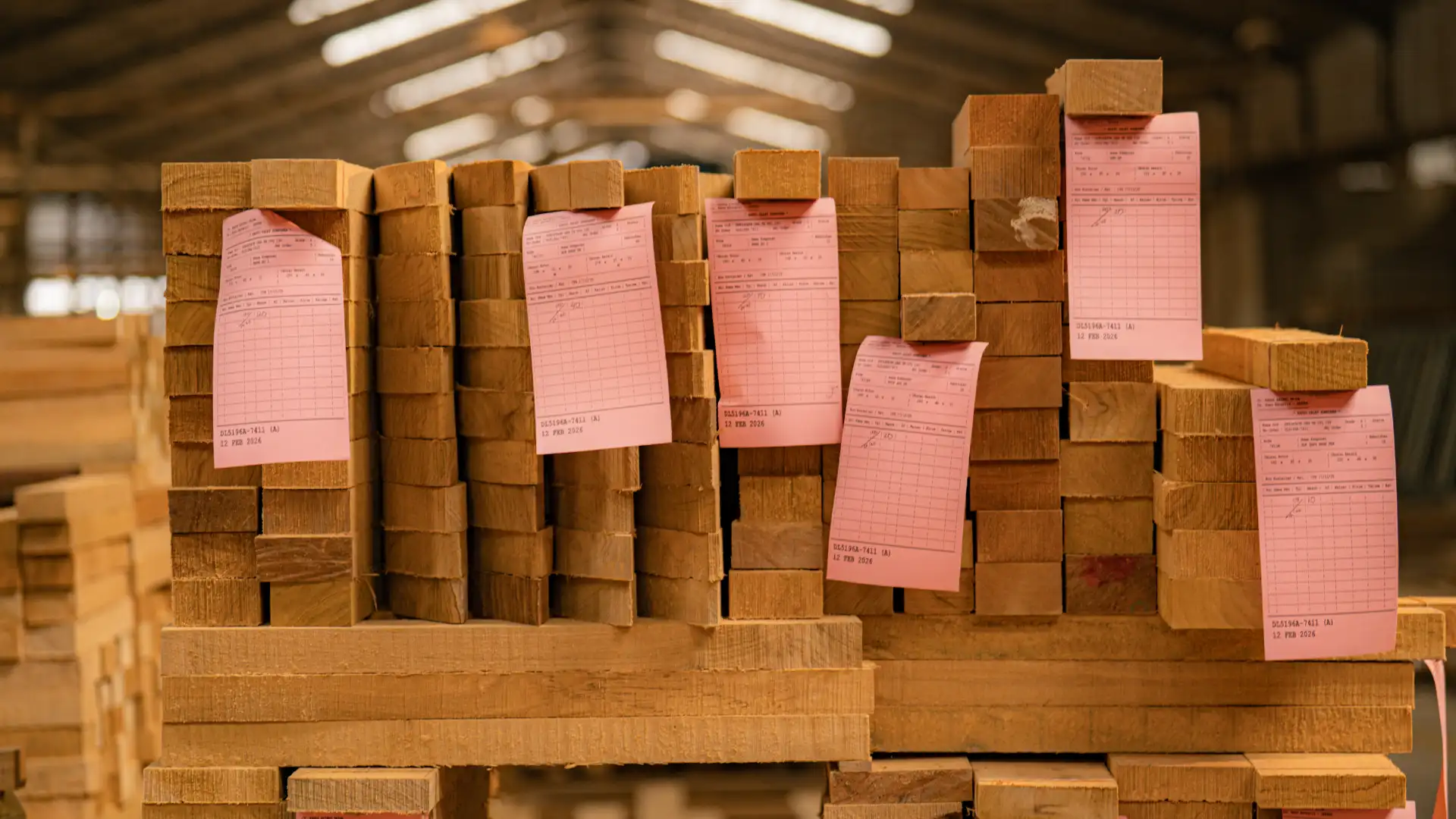
The process begins at the sawmill, where teak logs are cut into required dimensions. This is followed by approximately 12 days of controlled kiln drying to achieve an optimal moisture content of around 8%.
This moisture level is critical because it:
- Ensures structural stability
- Reduces the risk of deformation
- Strengthens joinery performance
- Aligns with international humidity standards
Precise temperature and humidity control inside the kiln chamber guarantee consistent results across production batches.
2. Surface Refinement
Once moisture levels meet export specifications, the wood proceeds to Mill 1. Stackline systems, Double Planers, and Sanding Master equipment refine the dimensions and smooth the surface.
At this stage, QC 1 performs detailed inspections of measurements, thickness tolerance, and surface quality. Components that fail to meet technical standards do not proceed to the next phase.
3. Precision Crafting
In Mill 2, components are processed using Tenoners, Mortisers, Spindles, and high-accuracy CNC machines. Mortise and tenon joinery is implemented as the structural standard due to its superior strength compared to conventional screw-based assembly.
The combination of controlled moisture content and precision joinery produces outdoor furniture capable of withstanding climate changes and long-term load stress.
4. Meticulous Assembly
During the QC setting stage, color consistency and texture harmony are verified to ensure visual uniformity. The assembly process follows standardized procedures to maintain structural accuracy.
Stable moisture levels achieved through kiln drying play a crucial role in preventing dimensional changes during assembly.
5. Finishing Touches
Finishing serves not only aesthetic purposes but also protective functions. Outdoor coating systems are applied to protect the wood from UV exposure, moisture, and temperature fluctuations.
When finishing is applied to properly kiln-dried teak, adhesion performance improves significantly, contributing to longer product lifespan and reduced surface failure.
6. Final Control & Delivery
Each product undergoes strict final quality control before being packed according to international export standards. Inspection criteria include structural integrity, finish consistency, color uniformity, and dimensional compliance.
Approved items are then packaged using export-grade packing systems designed to protect structural stability during long-distance sea freight.
Why Kiln Drying Determines Export Quality
Without properly controlled kiln drying, subsequent production stages lose precision. Fluctuating moisture levels can weaken joints, cause finishing cracks, and result in post-installation deformation in the destination country.
Within the teak export standard framework, a moisture content range of 8–12% is generally accepted to ensure cross-climate compatibility. For importers and quality inspectors, verifying moisture content before shipment is a critical quality assurance step.
Technical Conclusion for Global Buyers
Teak kiln drying is a decisive factor in determining the quality of export outdoor furniture. It ensures structural stability, performance reliability, and long-term durability across diverse international climates.
Through a precision-driven manufacturing approach—from material preparation to final quality control—export standards can be consistently maintained. For technical buyers and procurement professionals, understanding the importance of kiln drying is essential to securing long-term investment value in outdoor furniture sourcing.